
Nurse Financial Independence: The 5 Levels to Becoming Work Optional
May 31, 2026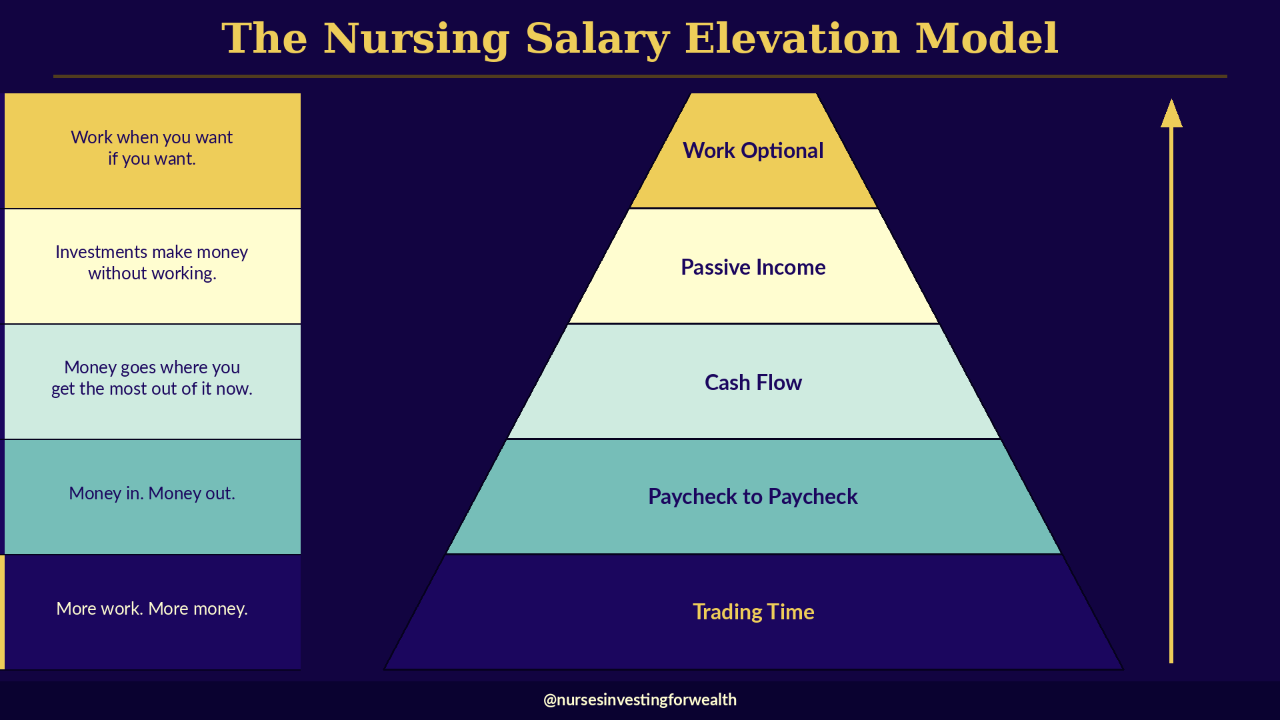
This story is heavy, but I want to share it to help you understand why this work is so important.
My commitment to helping nurses become work optional comes from a very personal place.
My father-in-law worked six days a week–never taking more than two weeks vacation his entire adult life. He was counting down the days to retirement so he could finally live on his own terms and spend time with his grandkids. He never made it. He died at 62, a few months after being diagnosed with glioblastoma, a lethal form of brain cancer.
When my husband and I got the news that his tumor had progressed much more rapidly than expected, we dropped everything and raced across the country to be with him.
We sat with him through his last two weeks because we could. We didn’t have to ask our boss for permission. We were not watching our accounts to calculate how long we could afford to stay. We had made nursing work optional years before, but we had no idea how much that would matter until that moment.
That is what nurse financial independence actually looks like. It’s that moment when you can drop everything because you need to.
Why a Bigger Paycheck Is Not the Answer
If you have ever wondered whether that kind of financial freedom is possible on a nursing salary, the answer is yes. But it’s not just about your paycheck. It happens when you learn how to invest what you earn, on your own, and follow a system to get to your goals.
Most nurses believe the path to financial independence is just about a higher salary. So they pick up extra shifts, go back for their NP, or move to a higher-paying specialty.
But what I’ve seen from the nurses I work with is that nurses who earn $80K are asking the same questions and experiencing the same problems as the nurses who earn $150K.
I tell nurses that you can’t work your way to wealth, because a bigger paycheck does not lead to financial independence on its own.
And it doesn’t happen all at once. It’s not like you’ll get that raise, and everything will suddenly be okay. What achieving financial independence actually looks like is a process of building a set of skills and resources. It happens over time, until eventually all of the pieces come together.
Regardless of your current salary, nurses move through a predictable set of stages, and use a predictable set of skills to get there, which every nurse has the ability to learn.
The 5 Levels of the Nursing Salary Elevation Framework
Level 1 — Trading Time
Every nurse starts here. Going to nursing school was one of the best investments you ever made. That credential gives you a skill you can use every day to earn a reliable salary. But the problem is that in order to keep making money, you have to keep showing up. More income requires more of your body, your time, and your energy. When nurses at this stage have extra expenses, they pick up extra shifts, or get a second job. It works in the short term, but inevitably this wears you out.
You know you are at the top of this level when you catch yourself thinking: “I cannot keep doing this. There has to be a different way.” (These are the nurses who may be mashing "I hate nursing" into Google 500 times a day...)
Level 2 — Paycheck to Paycheck
At Level 2, you are earning more than you ever have, and are being responsible. You are paying your bills, contributing to retirement, doing the things you were always told to do. But you still feel stuck. You are in a routine, but you don’t feel like you would be able to take time away from work and still make ends meet. When unplanned expenses come up it’s not exactly an immediate crisis, but you drain your savings and feel like you’re start over.
The feeling is not "I do not make enough." When you’ve topped out at this level, the feeling is: "I make more than I ever have and I still cannot get ahead. What is going on?"
Level 3 — Cash Flow
Level 3 is where the shift towards real financial independence begins. You get organized, stop just tracking where money went, and start deciding where it goes before it arrives. You make a plan for each paycheck, built around how nursing actually works. Variable income. Shift differentials. Travel contracts that start and stop. Stretches without pay. Unpaid administrative leave. When your car breaks down, you are able to pay cash and move on because you planned for it. When you take three months off because you’re burnt out, the bills are covered because you planned ahead.
This is often the level when nurses begin deciding to work less, because their finances feel under control. The anxiety that follows every direct deposit starts to ease. You are getting good at sending small portions of each paycheck to the right places, and you can feel the system working.
Nurses at the top of this stage are often looking around, thinking about ways that they can do even more with their paycheck.
Level 4 — Passive Income
At this level, Nurses develop investing skills that allow them to optimize the money they’re saving. They learn and apply wealth-building strategies like identifying and eliminating investment fees, and choosing appropriate investments based on their goals and tolerance for risk. This is where you begin to make money from investing, rather than trading your time for money.
This is where nurses often report feelings of excitement or even surprise. In this Level, nurses say things like “It feels like I’m cheating” because they begin to see themselves making a significant amount of money that does not require additional work.
Level 5 — Work Optional
This is the goal. Every level below this one builds toward this moment. Nurses here don’t necessarily leave their jobs, but now you have the ability to choose when or if you go to work. The reason? You have enough in your accounts that you can take the dividends your investments earned for the year, live on a portion of it, leave the rest untouched and growing, and come back next year to accounts that are bigger than when you left. You choose your shifts. You take the month of leave without pay without stressing about it. You show up at your child's soccer game without calculating how much money you’re losing in order to be there.
My husband and I had reached the beginning of this stage when his dad got sick. It’s what gave us the freedom to drop everything to be with him. It’s one reason that, to me, the goal is to help every nurse get to Level 5, as quickly as possible.
But it’s not the only reason to do this work. You’ll feel the benefits at every step. With each level, you feel less money stress, your life feels more under control, and this stops feeling like a dream and starts feeling like a process that’s actually happening for you.
What Moving Up Actually Takes
Making progress from Level 1 to Level 5 is not about earning a different salary. It is about building a nurse-specific investing system designed for variable income, shift differentials, travel contracts that start and stop, and the months where you simply do not have it in you to work.
The system I teach covers cash flow, debt, investing, and savings in the right order at the right time. Once it is set up, nurses run it in one hour a month. I built this system starting at $16 an hour with $200,000 in student debt. I made nursing work optional within six years of getting serious about it. Then I turned it into the first State Board of Nursing-approved continuing education investing program in the United States and Canada, so nurses everywhere could follow the same path.
Which level are you on right now? And what is one thing you’ll do to move up to the next one?
If you want to take the first step forward now, start by watching the free training below. It will show you where to start on the path towards becoming work optional.
💻 Free, On Demand, Video Training
Fellow Nurses: How to Become Work Optional in One Hour a Month–Without Burning Out, Wasting Time on One-Size-Fits All Finance Strategies, or Falling for Bogus Investment Ploys
